
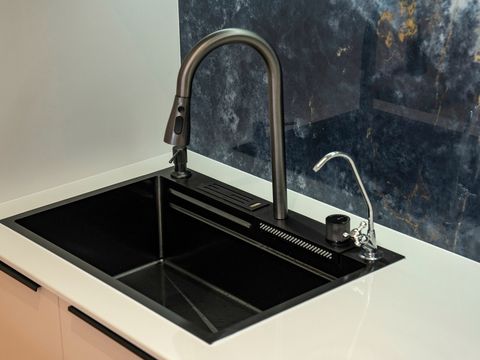
Signs a tap needs attention
- A drip from the spout once the tap is off.
- Water seeping from around the handle or the base of the spout.
- You have to force the handle closed to stop the drip.
- The handle spins without ever turning the water off.
- Water in the cupboard under the sink.
- A tap that bangs or shudders when you shut it: see water hammer.
Which kind of tap do you have?
| How to tell | What wears out | |
|---|---|---|
| Washer (compression) tap | Several full turns from off to full flow, and it gets tight as it closes | The rubber washer, the jumper valve and sometimes the brass seat it presses on |
| Ceramic disc tap | A quarter or half turn takes it from off to full | The ceramic cartridge inside, which is replaced as a unit |
| Mixer tap | One lever controls both flow and temperature | The mixer cartridge, plus O-rings at the spout |
What a plumber will do
A plumber will turn the water off at the nearest isolation valve, or at the meter if there is none, and take the tap apart to see which part has failed. For a washer tap, that means a new washer and jumper valve, and if the brass seat is pitted, reseating it so the new washer has something smooth to close on. Our tap washers page goes through that repair.
For ceramic and mixer taps, the plumber will match the cartridge to the brand and model. If the right cartridge is no longer made, they will talk through a new tap that fits the same holes or wall outlets.
Leaks under the sink are often the flexible hoses that feed the tap, or a loose waste fitting rather than the tap itself. A plumber can tell which, and replace hoses that are rusting or bulging before they let go.
What changes the job
Wall taps in a shower or over a bath have their bodies inside the wall, so access is tighter than for a sink mixer. Changing from two separate taps to one mixer may mean new holes in the benchtop or new outlets in the wall. If there are no isolation valves under the sink, the water goes off to the whole house during the repair, and the plumber may suggest fitting some. Older or imported tapware can mean a wait for parts.
What you can do yourself
You can
- Unscrew and clean the aerator on the end of the spout if the flow has gone weak or splashy.
- Find the isolation valves under the sink and check they turn, so you can stop a leak fast.
- Photograph the tap and any brand name: it helps the plumber bring the right cartridge.
- Queensland homeowners may replace "a jumper valve or washer in a tap", according to the QBCC's DIY plumbing guide.
- In Western Australia, the homeowner list allows "maintenance or repair of a tap (other than a thermostatic mixing tap)".
- The rules elsewhere are not the same. See what you can do yourself for your state.
Leave to a licensed plumber
- New tapware, unless your state's homeowner list covers it.
- Thermostatic mixing taps and valves, which control hot water temperature.
- Taps whose bodies sit inside a tiled wall.
- Any leak inside a wall or under a floor.
Rules that apply to tap work
In NSW, plumbing is specialist work, and a contractor licence is needed for "all specialist work regardless of its cost". The state's list of minor works that need no Notice of Work includes "replacing tap ware". So a straight swap needs no advance notice, but it is still licensed work.
Hot water at bathroom fixtures used for personal hygiene must be delivered at no more than 50°C. Kitchen and laundry taps are outside that rule. In places such as aged care, health care, early childhood centres and schools, the limit is 45°C. Only a thermostatic mixing valve or a thermostatically controlled tap may be used to meet it.
For what each state expects in paperwork, see our compliance certificate guide.
Questions to ask the plumber
- Is it the washer, the seat or the cartridge?
- Are parts still made for this tap, or is a new one the better use of money?
- Can you fit isolation valves while you are here?
- Do the flexible hoses under the sink need replacing too?
- Does a thermostatic tap need setting after the repair?

What we would do
A dripping washer tap is worth repairing, and a good plumber will reseat it rather than just jam in a new washer. For a cartridge tap, find out whether the cartridge is still made before deciding. If you are changing tapware anyway, get isolation valves fitted under every sink at the same visit: the next repair becomes a lot simpler. A plumber who handles tapware all the time will know which brands still have parts.