
When to call a plumber
- The garden tap drips no matter how hard you close it.
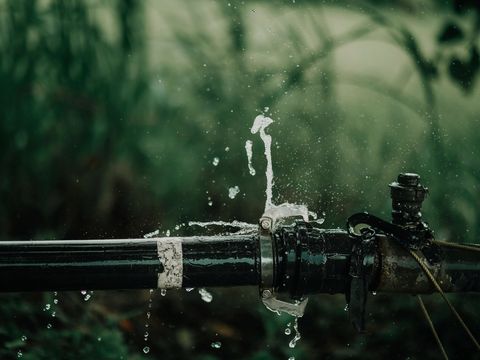
- Water runs down the brickwork from behind the tap.
- The ground under a freestanding garden tap stays soggy in dry weather.
- A tap has snapped off or been hit by a mower or a car.
- The washing machine taps are seized, or one weeps whenever the machine fills.
- You want a new tap at the front, side or back of the house where there is none.
Tap snapped off and water pouring out?
Turn the water off at the meter straight away. Then see burst pipes for what to do next, or ask for an emergency plumber if the water will not stop.
What a plumber will do
For a dripping outdoor tap, a plumber will usually replace the washer or the headgear, as with any washer tap. If the tap is old and crusted, a new tap is often the quicker fix.
Water coming from the wall behind the tap points to the fitting or pipe that feeds it. A plumber will open up enough to reach the joint, replace it and make the tap secure so it cannot twist the pipe again. Wet ground under a garden tap on a riser usually means the buried pipe or its joint has failed; finding that can take leak detection.
Washing machine taps are opened and closed so rarely that the washers harden and the spindles seize. A plumber will loosen or replace them, and can check the machine's inlet hoses while there.
What changes the job
How the pipe reaches the tap makes the biggest difference. A tap on a brick wall with the pipe behind it takes more care than one on an exposed pipe. Adding a new tap depends on how far it is from the nearest water pipe and what is in the way: paths, garden beds or a slab. If the tap is meant to run off a rainwater tank instead of the mains, the plumbing has to stay separate; see rainwater tanks.
What is yours to do
You can
- Turn washing machine taps off when you go away, and open and close them now and then so they do not seize.
- Replace a worn hose fitting or a perished hose washer on the hose side of the tap.
- In Queensland, the QBCC guide's list of unregulated work includes irrigation fed from downstream of a tap, an isolating valve or a backflow device.
- In Western Australia, a homeowner may maintain or repair a tap. A tap where there was none means new water supply pipework, which the state's homeowner page says "must be carried out by a licensed plumber or permit-holder."
- Other states have their own position. Check our guide to what you can do yourself before you start.
Leave to a licensed plumber
- Adding a tap, moving one, or running a pipe to a new spot.
- Leaks inside the wall or under the ground.
- A tap that turns the pipe behind it when you use it.
- Connecting taps to a rainwater tank.
Rules for outdoor tap work
Garden and hose taps sit on the drinking water supply, so the work is water supply plumbing. In NSW, a plumber needs a contractor licence whatever the job is worth. In Western Australia, it is an offence to knowingly engage an unlicensed person to do plumbing work, with a penalty of $5,000.
In Western Australia, repairing or replacing existing pipework counts as minor work: it needs a record, but no certificate of compliance. Other states handle paperwork their own way: see our compliance certificate guide.
Questions to ask the plumber
- Is the leak in the tap, or in the pipe behind it?
- Will you secure the tap so it cannot twist the pipe again?
- Does this tap need a vacuum breaker or other protection against water flowing back into the supply?
- Can the new tap go on the mains, the tank, or both?
- Should the washing machine hoses be replaced too?

What we would do
Fix a dripping garden tap now; it rarely gets better by itself and the water adds up over a summer. If water is coming from the wall or the ground, do not just replace the tap: get the pipe checked. When adding outdoor taps, plan them all in one visit, and decide up front which run off the tank. A plumber who does this kind of job often can tell you what will and will not work with your pipe layout.