
What each job involves
Relining. The plumber cleans the pipe thoroughly, then feeds a flexible liner soaked in resin into it through an existing access point. The liner is pressed against the old pipe wall and left to harden, forming a new pipe inside the old one. Where other pipes join the line, the plumber reopens those junctions from inside.
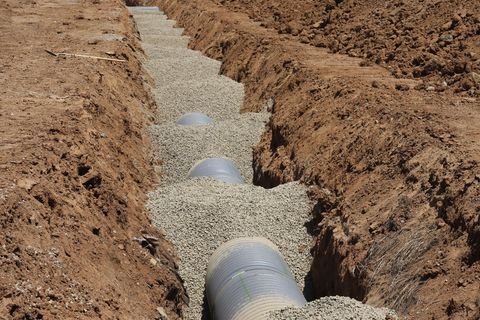
Digging and replacing. The plumber excavates down to the damaged section, cuts it out and lays new pipe. Then the trench is backfilled and whatever sat on top, lawn, paving or concrete, has to be put back.
Side by side
| Relining | Digging and replacing | |
|---|---|---|
| Digging | Little or none: the work goes in through access points | A trench along the damaged section |
| Suits | Cracks, leaking joints and root entry in a pipe that still holds its shape | Collapsed pipes, sags that hold water, and lines that need moving or new connections |
| What's on top | Driveways, paving and gardens can usually stay | Surfaces over the trench are lifted and restored |
| The pipe afterwards | Slightly narrower inside, because the liner takes up room | Can be the same size, or a different one if the plumber recommends it |
| Before work starts | A camera inspection and a full clean of the line | A camera inspection to find the bad section, and a check for other services in the ground |
Start with a camera inspection
Neither job should be quoted on a guess. A CCTV drain inspection shows where the damage is, how long the bad stretch runs and whether the pipe has lost its shape. Ask to see the footage while the plumber is there, and ask for a copy with the distances marked.
That copy matters later. It's what you show a second drain specialist if you want another opinion, and it's the record of what the pipe looked like before anyone touched it.
Signs relining may not suit your pipe
- The camera shows part of the pipe has collapsed or been crushed.
- There's a dip that holds water, so waste sits in the line.
- The pipe has to move, for example to make room for an extension.
- A new connection is needed partway along the line.
- The damage is at a junction the plumber isn't confident they can reopen.
Check whose pipe it is first
Before you pay for either job, find out whether the damage is on your side of the water company's connection. Each company sets that point differently, and our guide to who owns the sewer pipe quotes the ones we've checked.
Sydney Water, for example, says owners own the wastewater pipes "up to where they connect to our water system, including the point of connection". But it also says it "may repair" private wastewater pipes that have collapsed under a public footpath or road for residential customers, and sections "deeper than 2.5 metres". If your damage is there, ask Sydney Water before you book anyone.
Tree roots are often the reason a line fails. South East Water, for one, won't reimburse a blockage claim where "CCTV was used" or "Tree roots were cleared". Check your own company's rules before the root work starts.
The paperwork
The paperwork for drainage work depends on the state. In NSW, the plumber lodges a Notice of Work before starting and a Certificate of Compliance at the end, and drainage work also needs a Sewer Service Diagram. In South Australia, the electronic certificate of compliance covers sanitary plumbing and drainage, and you should get it within 7 days. WA treats fixing or swapping out existing pipework as minor work, which calls for a record of the job rather than a certificate.
Ask which applies to your job before it starts. Our compliance certificates guide has the details state by state.
Questions to ask before you choose
- Can I see the camera footage, with the distances marked?
- Exactly where is the damage, and is it on my side of the water company's connection?
- Why do you recommend relining, or digging, for this pipe?
- How will you reopen the junctions after the liner goes in?
- What will be dug up or disturbed, and who puts it back?
- What paperwork will I get when the job is done?
- What does your warranty cover, in writing, and does it mention tree roots?

What we would do
Get the camera footage first and keep your own copy, whoever does the work. Then ask a second drain specialist to look at the same footage and tell you whether they'd reline or dig, and why. If two plumbers working from the same pictures agree, go ahead. If they don't, their reasons are the most useful thing you'll hear, and they'll usually point you to the right answer.