
Relining in Brisbane: what to know
Roots tend to return
Urban Utilities rates tree roots as the leading cause of sewer blockages and says they often come back to a pipe they were cleared from. A drain cleared more than once is worth a camera inspection.
Council has the drainage plan
Brisbane City Council sells copies of house drainage plans, showing the private sewer drains in the ground, and offers virtual viewings for a fee. They leave out stormwater and water supply pipes.
Protected trees can block a trench
Under Council's Natural Assets Local Law, building within the root zone of a significant landscape tree, or construction beside or under protected vegetation, isn't exempt. That can mean a permit before anyone digs.
Digging near the sewer main
Urban Utilities' approval is needed for excavation closer than 3 m to the centreline of its water or sewer pipes. That rule can change the case for digging up a drain that runs near the main.
Is it your pipe to reline?
Urban Utilities owns the sewer from your property's connection point on, and that point can sit outside your boundary, even under the footpath. The pipe up to it is yours, and that's the length a private plumber can reline.
Past that point, it's Urban Utilities' pipe. Working within or near its assets without a Network Access Permit is an offence, so a good relining plumber stops at the connection point and reports anything beyond it to Urban Utilities.
Stormwater pipes are a separate system. Council maintains them beyond the boundary, and it has its own rules for building over the ones it owns.
Relining or digging: the Brisbane factors
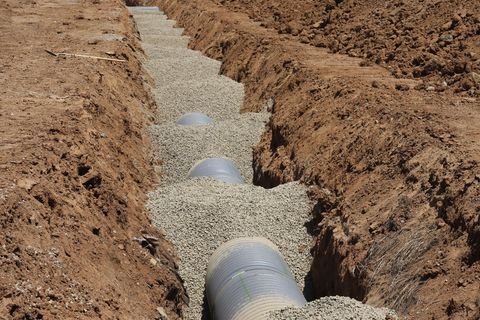
Digging can bring approvals into play: Urban Utilities for work near its mains, Council for protected trees, and Before You Dig Australia for every other service in the ground. Relining works through existing openings, so ask whether it avoids those steps on your block.
Brisbane City Council lists repairing a broken or damaged pipe as minor work: a licensed plumber, no permit. If the job changes your drainage layout, ask whether it becomes notifiable or permit work. Our relining vs replacement guide compares the methods.
How a relining job usually runs
Camera inspection
The plumber films the drain, measures the damage and marks where your pipe meets the sewer connection point.
Clean the pipe
Roots and build-up are cut or jetted out so the liner can bond.
Install the liner
The liner goes in through an existing opening and cures in place.
Film it again
A second camera run shows the finished pipe. Ask for both recordings and a written report.
Questions to ask the relining plumber
- Where is my sewer connection point, and does your work stop there?
- Can I keep the before and after footage?
- Are there trees near the line that would need a Council permit if we dug instead?
- Is any part of this near an Urban Utilities main or easement?
- Which kind of work is this with Council: minor, notifiable or permit?

What we would do
Get the camera report first, then ask the plumber to mark your connection point on it. If the damage sits on your side and runs under a tree, a slab or near a main, relining is worth pricing alongside a dig-up. If any of it sits past the connection point, report it to Urban Utilities rather than paying to fix its pipe. Keep the footage as a record of the drain for the future.